
Where Federal Releases Lead
A release from BOP custody ends the person's confinement in that federal prison episode. It does not necessarily end federal supervised release, parole in an older case, immigration action, a state sentence, or a separate county hold. The BOP itself cautions that a person shown as released might remain under another form of legal control.
Custody can also run in the other direction. A defendant held at the Tillman County Law Enforcement Center under a federal arrangement may leave the local roster because the U.S. Marshals Service moved the person. That departure is a transfer, not a community release. The sheriff's destination field and the federal case identify the next custodian.
Leaving the Tillman County jail and leaving BOP custody are separate events. Confirm each event in the system that held the person.
Confirm a BOP Release
The BOP Inmate Locator is the official person-search tool for federal prison records. It generally covers federal releases since 1982. Older federal records may require the National Archives route described by BOP.
- Search by BOP register number, INS number, FBI number, or DCDC number when one is known.
- For a name search, enter the name and use race, sex, and age filters only as supported by the record.
- Compare the register number and identity fields before opening or relying on a result.
- Read the exact location and release-date fields. Look for a past date and the word RELEASED.
- Check the federal case and any Tillman County record to learn whether another custody or supervision event followed.
A no-result does not establish community release. It can reflect spelling, a record outside the locator's date coverage, a person who was never in BOP custody, or a different federal detention stage.
Federal Release Result Fields
BOP results use a compact set of fields. Their meaning depends on the date and location shown together.
| Result field | Use | Limit |
|---|---|---|
| Register number | Distinguishes the federal record | Does not identify a county booking |
| Age, race, sex | Helps compare identities | Must not replace stronger identifiers |
| Release date | Reports a scheduled or past federal date | Context determines whether it is completed |
| Location | Names a facility or displays RELEASED | Does not show all other custody |
The captured official federal search interface shows the two supported search routes.
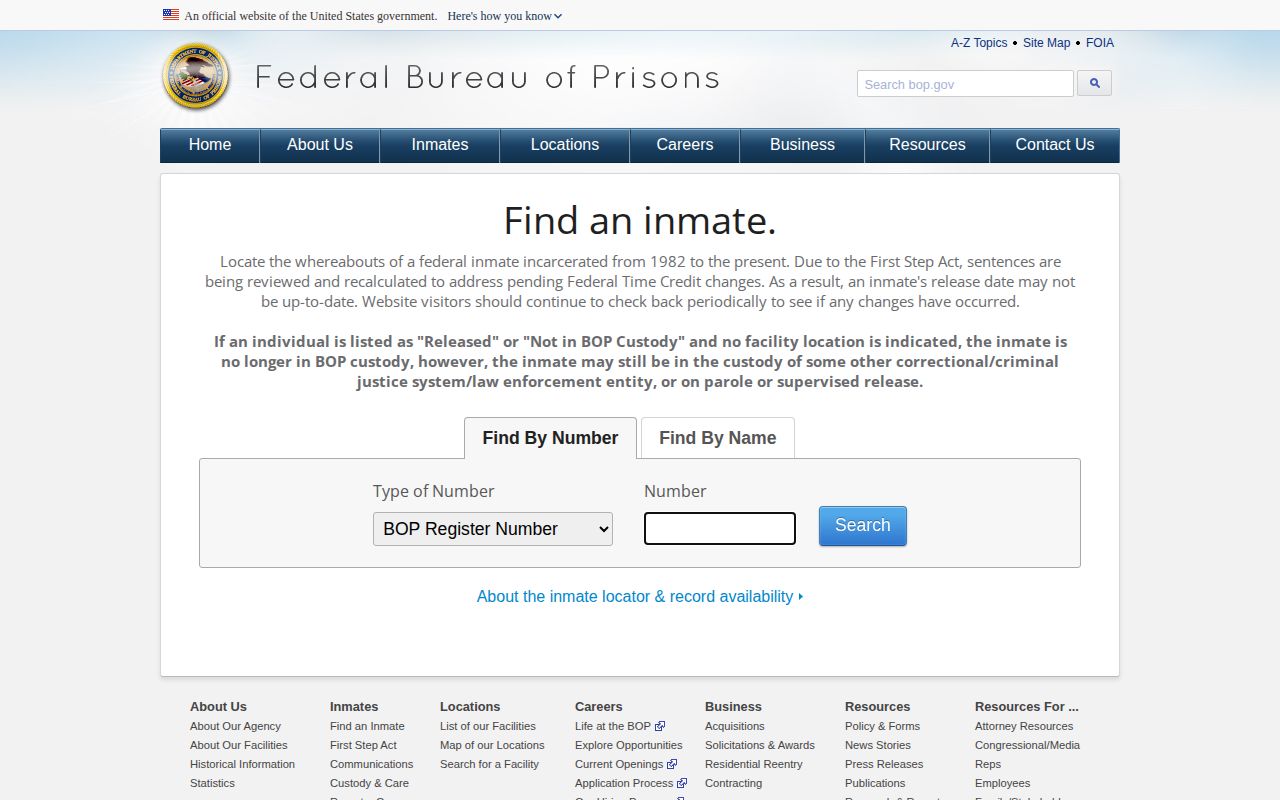
Use an assigned number when possible because it is more precise than a common name.
What BOP Released Means
BOP's federal inmate records explanation defines how the locator uses Release Date, UNKNOWN, and RELEASED. A past date paired with no current facility or a RELEASED location indicates that the person is no longer in BOP custody. It does not establish why a Tillman County jail record ended, whether a state took custody, or whether supervised release remains.
Federal supervised release is imposed by the sentencing court and managed outside prison. It should not be confused with Oklahoma parole or probation. Likewise, a federal release date does not resolve an immigration hold. If another agency assumed control at the prison gate, the next agency's record is needed.
- BOP release
- The federal prison custody episode has ended.
- Supervised release
- A federal court-ordered period in the community after imprisonment.
- USMS transfer
- A movement under U.S. Marshals authority, not proof of community release.
- Detainer
- A notice that another authority may seek custody.
Tillman Federal Custody Handoffs
No federal prison is documented within Tillman County. The local Law Enforcement Center is nevertheless a contract-housing jail, and a 2021 public audit documented U.S. Marshals housing. This creates a key local distinction: a person can depart the building because the controlling federal authority moved them, even though the local roster no longer displays the name.
Ask the Tillman County Sheriff for the release or transfer transaction, including the recorded date, time, type, and receiving agency. If the entry identifies USMS, follow the federal case and BOP process. The official Sheriff page names Sheriff Oscar Juanes, lists the office at 1200 S. Main in Frederick, and gives 580-335-3013. It publishes no verified historical release feed, so a direct record request is more reliable than a commercial jail directory.
The Law Enforcement Center page identifies the local jail but offers no federal history search. The Tillman County Court Clerk page identifies the office for the district case trail. A federal case must still be followed in the federal court system because a county docket cannot establish a BOP release.
Note: A local departure coded as transfer should never be rewritten as a federal or community release.
Federal Release Record Requests
The locator is the quickest public status tool, but it is not a complete federal case file. For a BOP record, begin with BOP's published records procedures. For a U.S. Marshals custody or movement record, use the USMS Freedom of Information Act route. USMS does not operate a public historical release locator comparable to BOP.
A focused request should identify the full legal name, federal register or case number, approximate dates, and the particular existing record sought. Avoid asking an office to infer a community release from a transfer. Privacy exemptions and records rules may limit what a public requester receives.
Federal custody routes
BOP Inmate Locator: online person search
USMS: Freedom of Information Act request
Federal case: issuing federal court docket
Cross-Check Federal Release Status
Start with the agency that most recently held the person. A Tillman sheriff transaction can establish a move out of the local jail. The BOP locator can establish the federal prison status. The federal court docket can explain a sentence and supervised-release term. ICE must be checked separately when immigration custody is plausible.
Do not use Oklahoma VINE or the ODOC lookup as a substitute for BOP. VINE is not the primary federal locator, and ODOC covers Oklahoma state custody and supervision. The Tillman County released-inmate search path lays out the choice among county, state, federal, and immigration records.
Final confirmation should pair identity with the register number and reconcile the past BOP date with any later custodian. That method answers what the federal result proves without stretching it beyond its scope.
BOP Record Coverage Limits
BOP explains that the public locator generally covers federal inmates incarcerated from 1982 to the present. A person released before that period may require an archival search through the National Archives. The locator also does not replace a federal court docket, pretrial detention record, USMS movement record, or immigration record. A person can appear in one of those systems without ever receiving a BOP prison record.
The word UNKNOWN in a release-date field is not a release finding. It indicates that the public locator does not supply a usable date in that record. A future date is not proof that the event happened, and a past date should be read with the location field. When RELEASED appears, it means no longer in BOP custody, not that the conviction disappeared or every court condition ended.
For an older or incomplete result, retain the exact name, register number, and displayed wording. Then identify the federal court and docket number. A sentence modification, revocation, or later case can change the custody story. The Tillman County docket is relevant only when a local case or local jail event also exists.
Tillman and Federal Records Differ
A Tillman County booking record can show the arresting or holding agency, county booking number, local charges, bond, departure time, release code, and destination when those facts are kept. A BOP result instead uses the federal register number, federal identity fields, location, and release date. Neither record should be expected to reproduce the other.
If the local record says the person bonded out, there may be no BOP search to perform. If it says USMS transfer, the federal trail becomes important. If BOP later says RELEASED, compare the federal date with the court's supervised-release terms and any new receiving agency. These checkpoints prevent the common mistake of turning one building departure into a claim that all custody ended.
Federal release verification should also account for data timing. An agency move can occur before the public locator refreshes. Record the time each source was checked, then call the responsible office if immediate confirmation is needed for a permitted personal, notification, court, or legal-process purpose.